KLIF GitHub Download
  • System 232.5 tok/s
  • System 1online · gemma 4
  • System CGIimage · step 5/8
  • System 3offline
  • Musiconline · yue2
New0.4: your agent lends its GPU and gets it back

Your local models, one window.

Language models, images, speech, music and video: KLIF starts the servers you already use, shows what each one does to your GPU right now, and stops them again. Nothing hidden, nothing bundled.

Trailer · KLIF 0.3 in one minuteWatch on YouTube
> klif-cli status
SYSTEM  STATUS   MODEL          SPEED
s1      online   gemma 4 26b
s2      busy     qwen 3.8 27b   32.5 t/s
cgi     busy     qwen image 2.1 12.4 s
s3      offline  flash-next
> klif-cli launch s3 --yes --wait

For people and for agents

Everything the window does, klif-cli does too.

JSON with a stable schema, an Agent Skill that teaches the contract in one file, and --yes wherever something starts or stops.

  • Kinds

    6

    llm · image · tts · stt · music · video

  • Platforms

    3

    Windows · macOS · Linux

  • Skins

    9

    full window and compact

  • Slots

    3

    conversations per System

  • License

    MIT

    free, open source

  • Weights shipped

    0

    you bring the models

New in 0.4 · leases

Your agent lends its GPU, then gets back to work.

One card, several models. An agent whose own model runs in KLIF hands the GPU to another System for one job and picks its conversation up where it left it, all in one tool call.

> klif-cli lease cgi --yes --from s1 -- python make_sprites.py

exit 0 · everything back

  1. 1System 1 is parked, its conversation saved into a slot.
  2. 2System CGI starts on the GPU System 1 left.
  3. 3The job runs: your command, a batch of requests, or one question.
  4. 4System CGI stops.
  5. 5System 1 is back with its conversation loaded, and the tool call returns.
One tool callklif-cli lease returns only when everything is back, also when the job fails or the System faults, and its exit code says which. If klif-cli itself is killed, KLIF restores without it.child_failedrestore_failed
Any System for any otherRun a command against the lent System, send it a batch of chat, image, speech or music requests and collect the answers in a folder, or let System 1 ask System 3 one question.-- command--requests--ask
The conversation survivesOn llama.cpp and Strata the parked System's KV cache goes into a slot of its own and comes back, so a long context is not read again. While it is parked, its port answers 503 with Retry-After: a client waits instead of failing.slots503 + Retry-After

What it does

One window, every server.

  • Systems

6kinds

Every server is a tab.

System 1, System 2, System CGI, System TTS, or whatever you call yours. Each one has its own server, session, logs and telemetry, and shows online, busy, starting, offline or fault at a glance. KLIF checks ports, exclusive GPUs and free VRAM before a launch, and never kills a process it does not own.

  • llm
  • image
  • tts
  • stt
  • music
  • video
  • Conversation slots

200Ktokens kept

A long session survives a restart.

A llama.cpp or Strata System saves what its server holds, the KV cache of a long conversation, into one of three slots on disk and loads it back, so a 200K-token session is not read again. Every skin has the three slot keys: click loads, holding saves.

  • 3 slots per System
  • auto-save on stop
  • auto-load on start
  • Presets

1command line

What you see is what runs.

A preset is the launch command: program, arguments, working folder, environment. The Options drawer, klif-cli plan and klif.toml show the same thing. Params such as reasoning on or off, or the image size, replace a folder of near-identical scripts.

  • Options drawer
  • klif-cli plan
  • klif.toml
  • params
  • Nodes and records

2machines, one window

A Mac on a Windows desk, and back.

Another computer running KLIF can offer its Systems to this one: opt-in, token-authenticated, off by default. KLIF also keeps your records, the best decode, prefill and time per image each model file reached on each backend, from everyday use.

  • remote nodes
  • external servers
  • records
  • klif-webui for a phone

Nine skins · same data

Pick a look, keep the numbers.

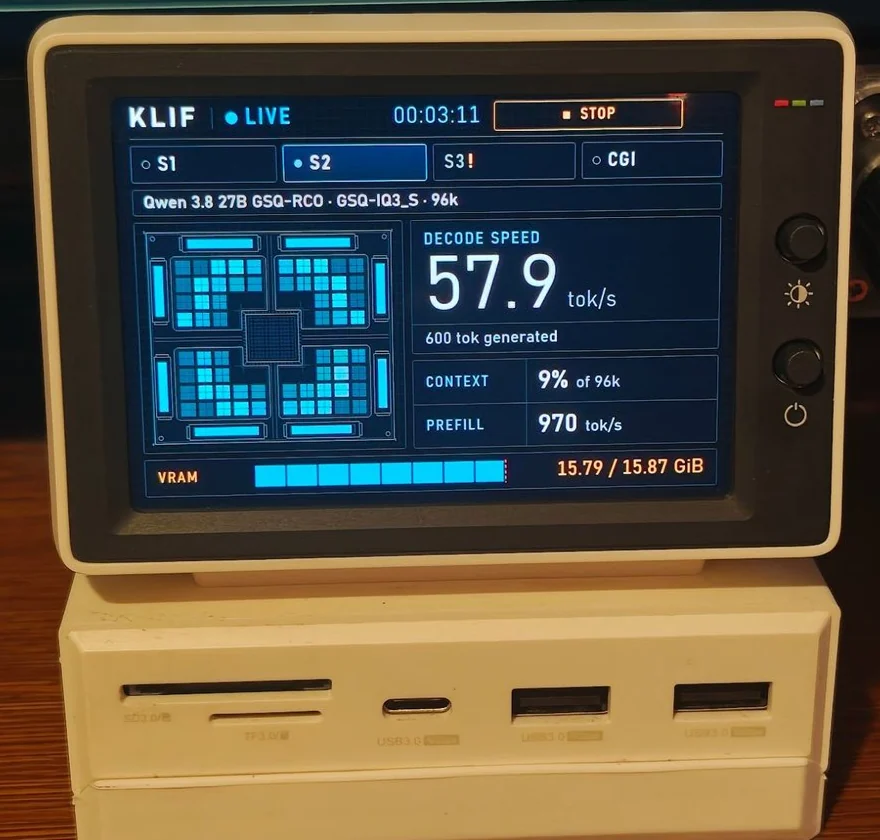
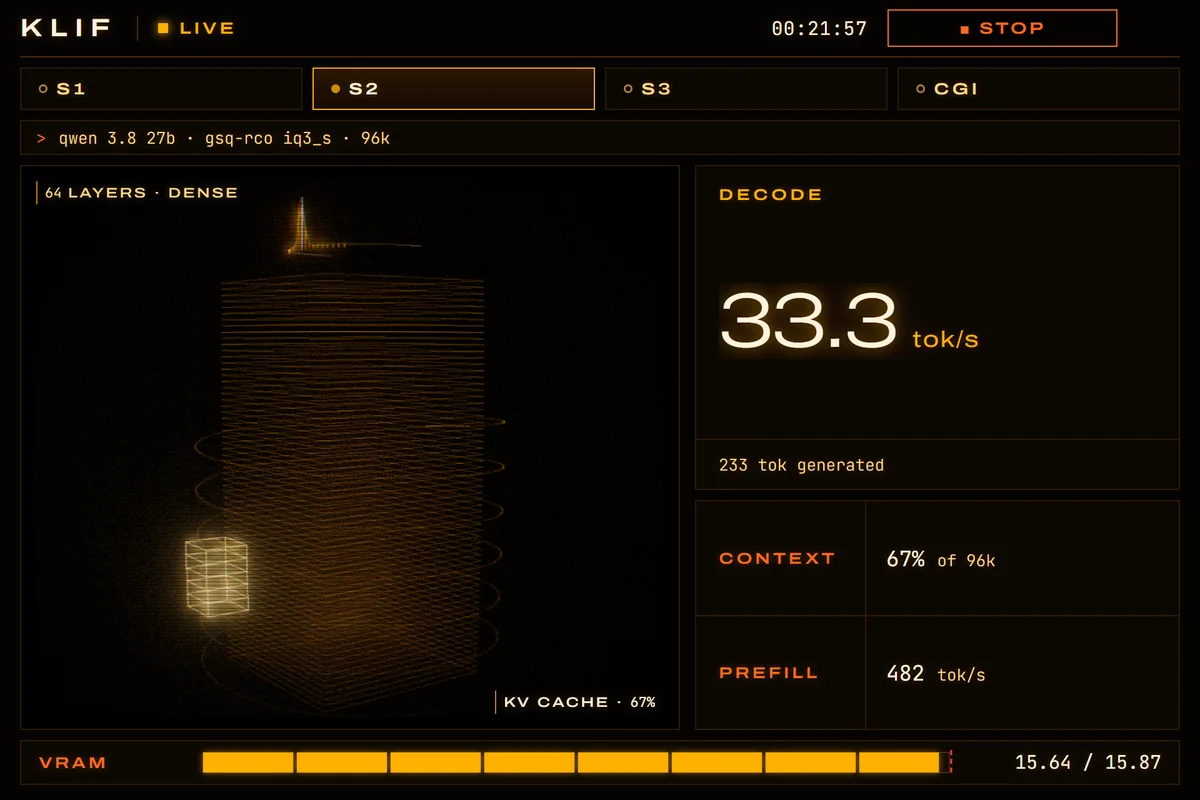
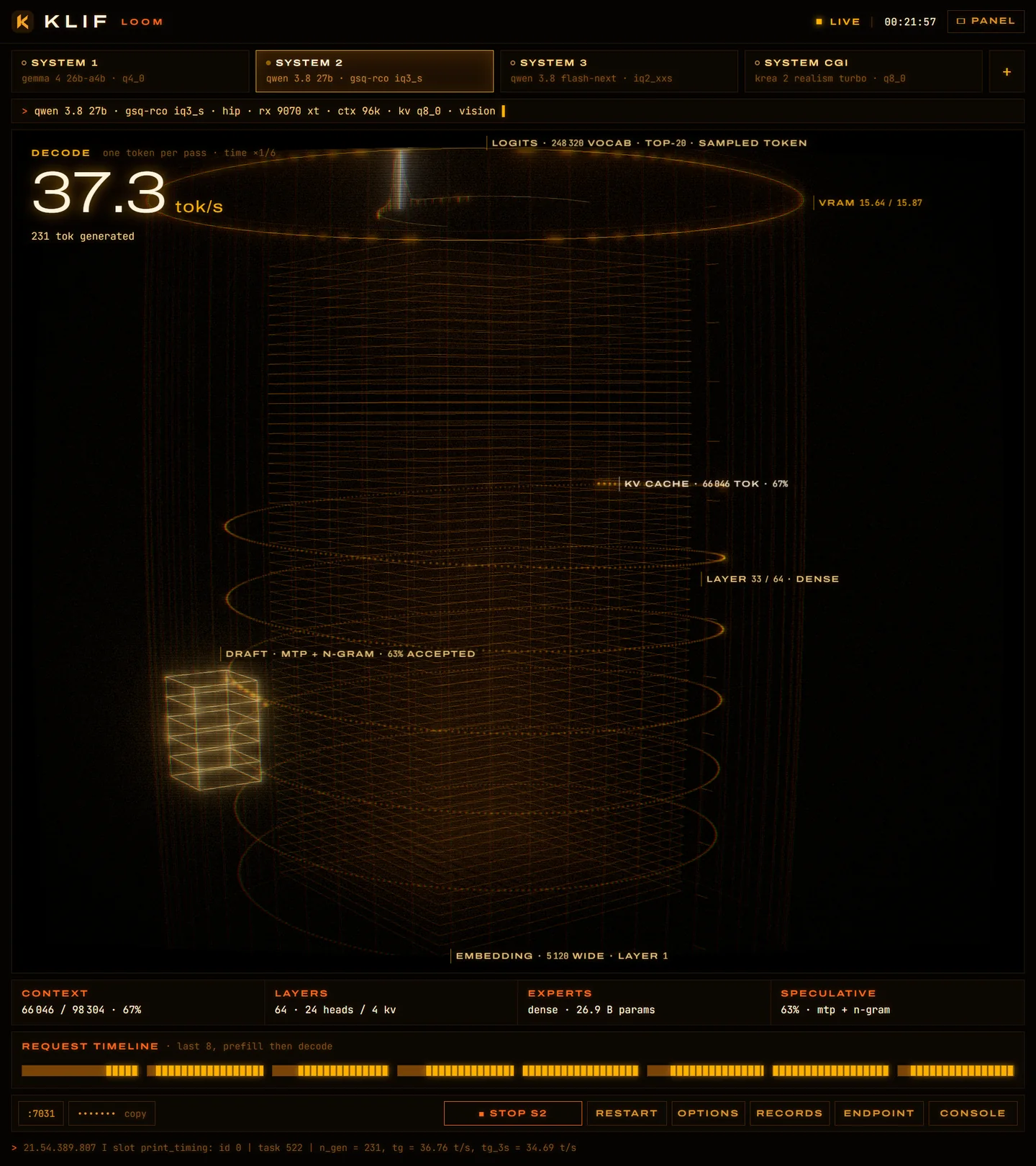
Every skin draws the same live telemetry, in a full window and in a 960×640 layout. F2 cycles them, and a System can have its own.

Loom

The transformer in 3D on an amber phosphor screen: layers, experts, KV cache.

Compact · 960×640
The Loom skin's small layout, 960×640
Window · 1280×1440, half a screen
KLIF in the Loom skin, in a window half a screen wide

Widescreen · 1280×800 · choose a skin to see its other two layouts above

All nine at once · top: the window · bottom: the 3.5-inch panel

From a launcher script to a stack

Four versions, one desk.

KLIF was built for daily work with local models on one machine, and that is still what it is for. Features land when they solve a real problem there.
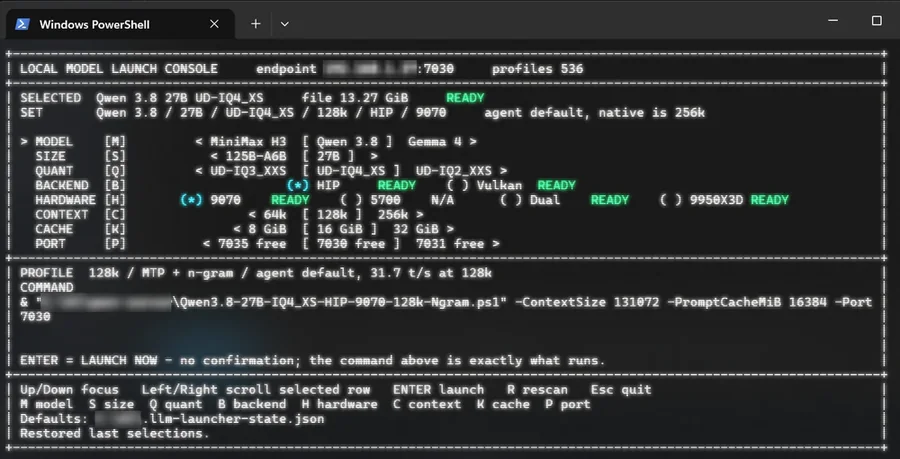
  • The terminal launcher: a PowerShell menuindev

    A PowerShell menu: model, quant, backend, GPU, context, port. Press Enter.

    one server at a time
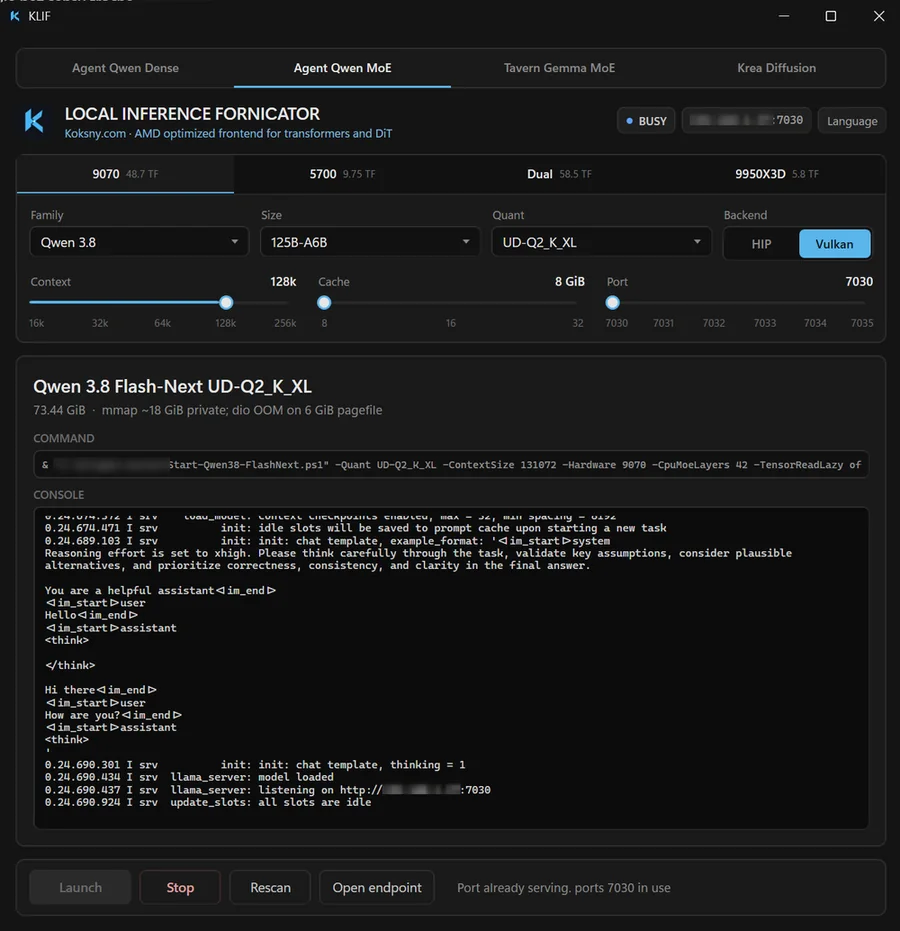
  • KLIF 0.10.1

    The same idea in a window: a tab per model tier, the command and its console.

    the name, the mark
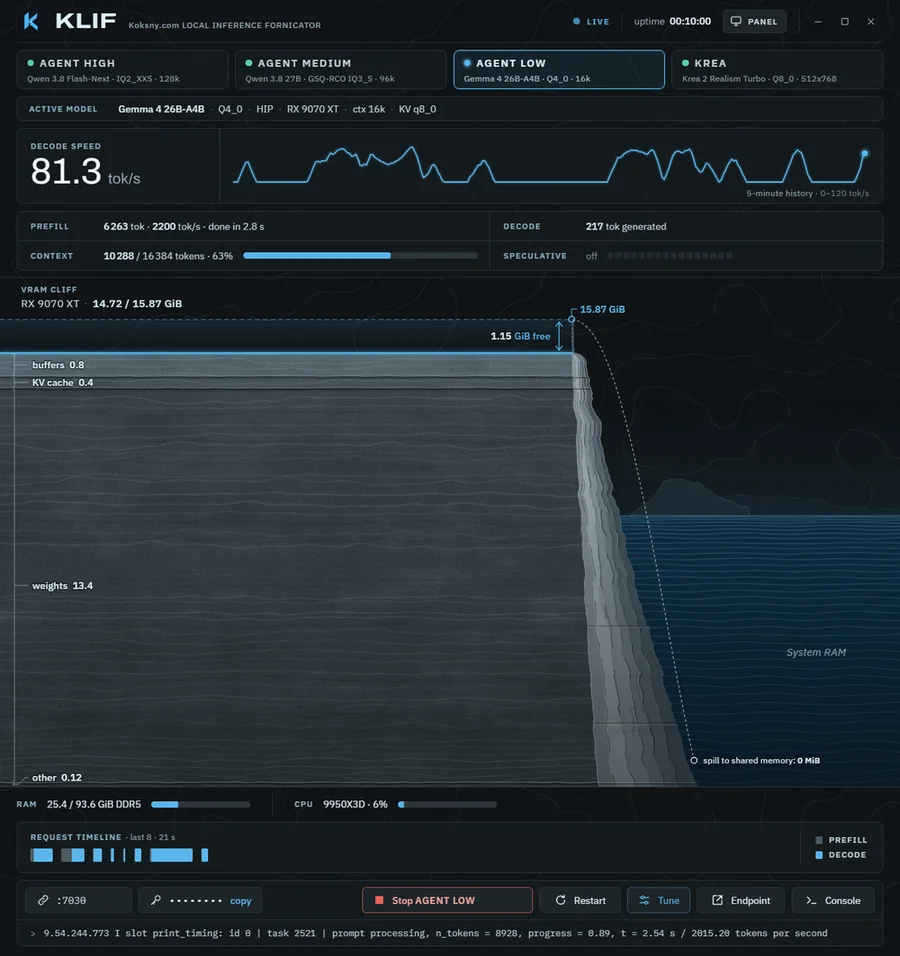
  • KLIF 0.20.2

    A native core and klif-cli, live GPU memory, a panel mode, the first skins.

    Tauri, Rust
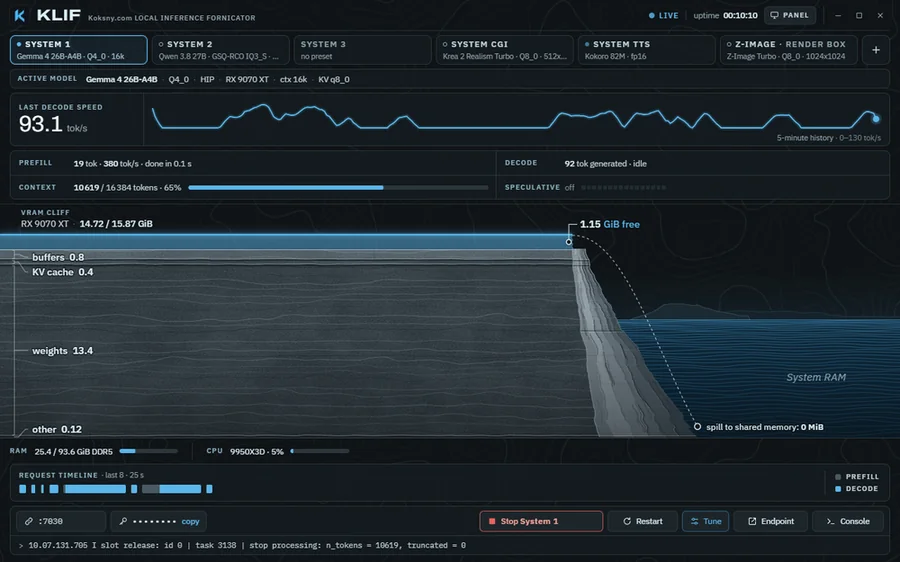
  • KLIF 0.30.3 · 0.4

    Any number of Systems, other machines, editable commands, downloads, a CLI for agents, and leases.

    Now 0.4.0

Platforms

Three systems, any build.

A preset is a plain command, so KLIF launches whatever build of a server you use: CUDA, HIP, Vulkan, SYCL, Metal or CPU.

Get KLIF · 0.4.0

Free, MIT, on GitHub.

Windows, macOS and Linux builds with their SHA-256 on the release page. Or build it yourself: Rust, Node.js, one script.